✨ New Arrivals Just Dropped!Explore
HomeStore
Australia’s Anti-Corruption Bodies: Strengthening Trust? Edited by Scott Prasser and David Clune
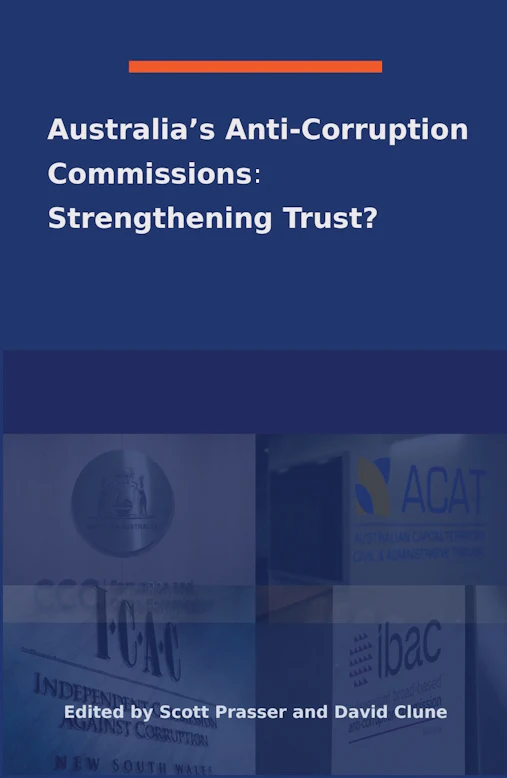
Australia’s Anti-Corruption Bodies: Strengthening Trust? Edited by Scott Prasser and David Clune
Australia’s Anti-Corruption Bodies:
Strengthening Trust?
Edited by Scott Prasser and David Clune
Hardback, 382 pages, $79.95
ISBN 9781023568297
Release Date Mid-April 2026
This volume is the first comprehensive overview in book form of Australia’s network of anti-corruption commissions. Australia is the only Westminster democracy with such bodies, whose antecedents derive in part from developments in Asia rather than elsewhere. Seven of the nine commissions are analysed by relevant experts, from Australia’s first anti-corruption body, the New South Wales Independent Commission Against Corruption formed in 1988, to the most recent, the National Anti-Corruption Commission established in 2023.
Given anti-corruption commissions exist in all nine Australian jurisdictions and several have been operating for over three decades, now is an appropriate time to assess and compare: how these different bodies perform; their roles compared to ad hoc royal commissions; the different factors that led to their formation; their various powers; controversies, successes and failures; their impact on civil liberties; relations with executive government and parliament; issues of accountability; their overall impact and effectiveness; and their place in the architecture of modern Australian government.
In identifying and explaining the similarities and differences of anti-corruption bodies across the jurisdictions this volume asks whether there is an ideal model? Has there been any learning by later bodies from their predecessors? Has the just formed NACC, for instance, reflected any lessons learnt from all the previous state and territory bodies that went before it?
Contents
Foreword - Professor John McMillan
Preface and acknowledgments – The Editors
Introduction – Scott Prasser
Part 1: The background
1 Corruption in the Premier State: An Historical Overview – David Clune
2 Origins of the New South Wales Independent Commission Against Corruption – Gary Sturgess
Part 2: Issues about Anti-Corruption Commissions
3 Anti-Corruption Commissions and Human Rights: Inherent Tensions – Anita Mackay
4 Permanent Anti-Corruption Commissions and Ad Hoc Commissions of Inquiry: A Comparison – Scott Prasser
5 Anti-Corruption Commissions: Where do They Fit in the System? – Yee-Fui Ng
Part 3: Anti-Corruption Bodies across Australian Jurisdictions
6 The NSW ICAC and Criminal Justice – Chris Merritt
7 The Queensland Anti-Corruption Commission: Summary History and Critique – Tim Prenzler and Janet Ransley
8 The Rollercoaster Ride of the Western Australia Corruption and Crime Commission – John Phillimore, Sarah Howe and Peter Wilkins
9 The Victorian Independent Broad-based Anti-Corruption Commission – Still a “toothless tiger”? – Pascale Chifflet and Meribah Rose
10 South Australia’s Independent Commission Against Corruption – James Marcus
11 Canberra’s Corruption Commission: Patrolling a Quiet Beat – Gary Humphries
12 The National Corruption Commission: A Faltering Start – Gary Humphries
Contributors
Pascale Chifflet, Senior Lecturer, Monash University Law School
David Clune, previously Manager of the NSW Parliament’s Research Service, the NSW Parliament’s Historian and currently an Honorary Associate in the Department of Government and International Relations, University of Sydney
Yee-Fui Ng, Associate Professor, Monash University Law School
Chris Merritt, Vice-President of the Rule of Law Institute of Australia
John Phillimore, Executive Director, John Curtin Institute of Public Policy, Curtin University
Scott Prasser, independent researcher
Sarah Withnall Howe, Senior Lecturer, School of Law and Criminology, Murdoch University
Gary Humphries, former Deputy President of the Commonwealth Administrative Appeals Tribunal
Dr Anita Mackay, Senior Lecturer, La Trobe University Law School
John McMillan, former Commonwealth Ombudsman and Emeritus Professor in Law from ANU
James Marcus, a barrister specialising in criminal and disciplinary law
Tim Prenzler, Professor of Criminology, University of the Sunshine Coast
Janet Ransley, Professor at Criminology Institute and deputy director of its Transforming Corrections to Transform Lives Centre, Griffith University
Meribah Rose, Lecturer in Criminology, La Trobe University Law School
Gary Sturgess, former academic and public servant who created the original design for the NSW Independent Commission Against Corruption
Peter Wilkins, Adjunct Professor, John Curtin Institute of Public Policy, Curtin University
$739.76
Original: $2,465.86
-70%Australia’s Anti-Corruption Bodies: Strengthening Trust? Edited by Scott Prasser and David Clune—
$2,465.86
$739.76Product Information
Product Information
Shipping & Returns
Shipping & Returns
Description
Australia’s Anti-Corruption Bodies:
Strengthening Trust?
Edited by Scott Prasser and David Clune
Hardback, 382 pages, $79.95
ISBN 9781023568297
Release Date Mid-April 2026
This volume is the first comprehensive overview in book form of Australia’s network of anti-corruption commissions. Australia is the only Westminster democracy with such bodies, whose antecedents derive in part from developments in Asia rather than elsewhere. Seven of the nine commissions are analysed by relevant experts, from Australia’s first anti-corruption body, the New South Wales Independent Commission Against Corruption formed in 1988, to the most recent, the National Anti-Corruption Commission established in 2023.
Given anti-corruption commissions exist in all nine Australian jurisdictions and several have been operating for over three decades, now is an appropriate time to assess and compare: how these different bodies perform; their roles compared to ad hoc royal commissions; the different factors that led to their formation; their various powers; controversies, successes and failures; their impact on civil liberties; relations with executive government and parliament; issues of accountability; their overall impact and effectiveness; and their place in the architecture of modern Australian government.
In identifying and explaining the similarities and differences of anti-corruption bodies across the jurisdictions this volume asks whether there is an ideal model? Has there been any learning by later bodies from their predecessors? Has the just formed NACC, for instance, reflected any lessons learnt from all the previous state and territory bodies that went before it?
Contents
Foreword - Professor John McMillan
Preface and acknowledgments – The Editors
Introduction – Scott Prasser
Part 1: The background
1 Corruption in the Premier State: An Historical Overview – David Clune
2 Origins of the New South Wales Independent Commission Against Corruption – Gary Sturgess
Part 2: Issues about Anti-Corruption Commissions
3 Anti-Corruption Commissions and Human Rights: Inherent Tensions – Anita Mackay
4 Permanent Anti-Corruption Commissions and Ad Hoc Commissions of Inquiry: A Comparison – Scott Prasser
5 Anti-Corruption Commissions: Where do They Fit in the System? – Yee-Fui Ng
Part 3: Anti-Corruption Bodies across Australian Jurisdictions
6 The NSW ICAC and Criminal Justice – Chris Merritt
7 The Queensland Anti-Corruption Commission: Summary History and Critique – Tim Prenzler and Janet Ransley
8 The Rollercoaster Ride of the Western Australia Corruption and Crime Commission – John Phillimore, Sarah Howe and Peter Wilkins
9 The Victorian Independent Broad-based Anti-Corruption Commission – Still a “toothless tiger”? – Pascale Chifflet and Meribah Rose
10 South Australia’s Independent Commission Against Corruption – James Marcus
11 Canberra’s Corruption Commission: Patrolling a Quiet Beat – Gary Humphries
12 The National Corruption Commission: A Faltering Start – Gary Humphries
Contributors
Pascale Chifflet, Senior Lecturer, Monash University Law School
David Clune, previously Manager of the NSW Parliament’s Research Service, the NSW Parliament’s Historian and currently an Honorary Associate in the Department of Government and International Relations, University of Sydney
Yee-Fui Ng, Associate Professor, Monash University Law School
Chris Merritt, Vice-President of the Rule of Law Institute of Australia
John Phillimore, Executive Director, John Curtin Institute of Public Policy, Curtin University
Scott Prasser, independent researcher
Sarah Withnall Howe, Senior Lecturer, School of Law and Criminology, Murdoch University
Gary Humphries, former Deputy President of the Commonwealth Administrative Appeals Tribunal
Dr Anita Mackay, Senior Lecturer, La Trobe University Law School
John McMillan, former Commonwealth Ombudsman and Emeritus Professor in Law from ANU
James Marcus, a barrister specialising in criminal and disciplinary law
Tim Prenzler, Professor of Criminology, University of the Sunshine Coast
Janet Ransley, Professor at Criminology Institute and deputy director of its Transforming Corrections to Transform Lives Centre, Griffith University
Meribah Rose, Lecturer in Criminology, La Trobe University Law School
Gary Sturgess, former academic and public servant who created the original design for the NSW Independent Commission Against Corruption
Peter Wilkins, Adjunct Professor, John Curtin Institute of Public Policy, Curtin University